
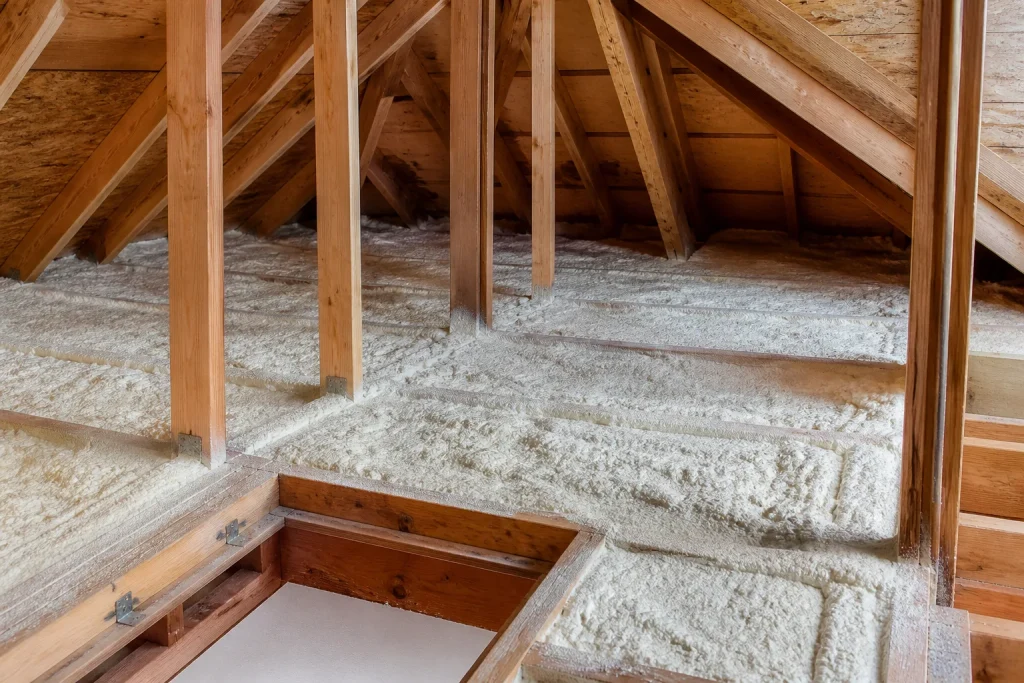
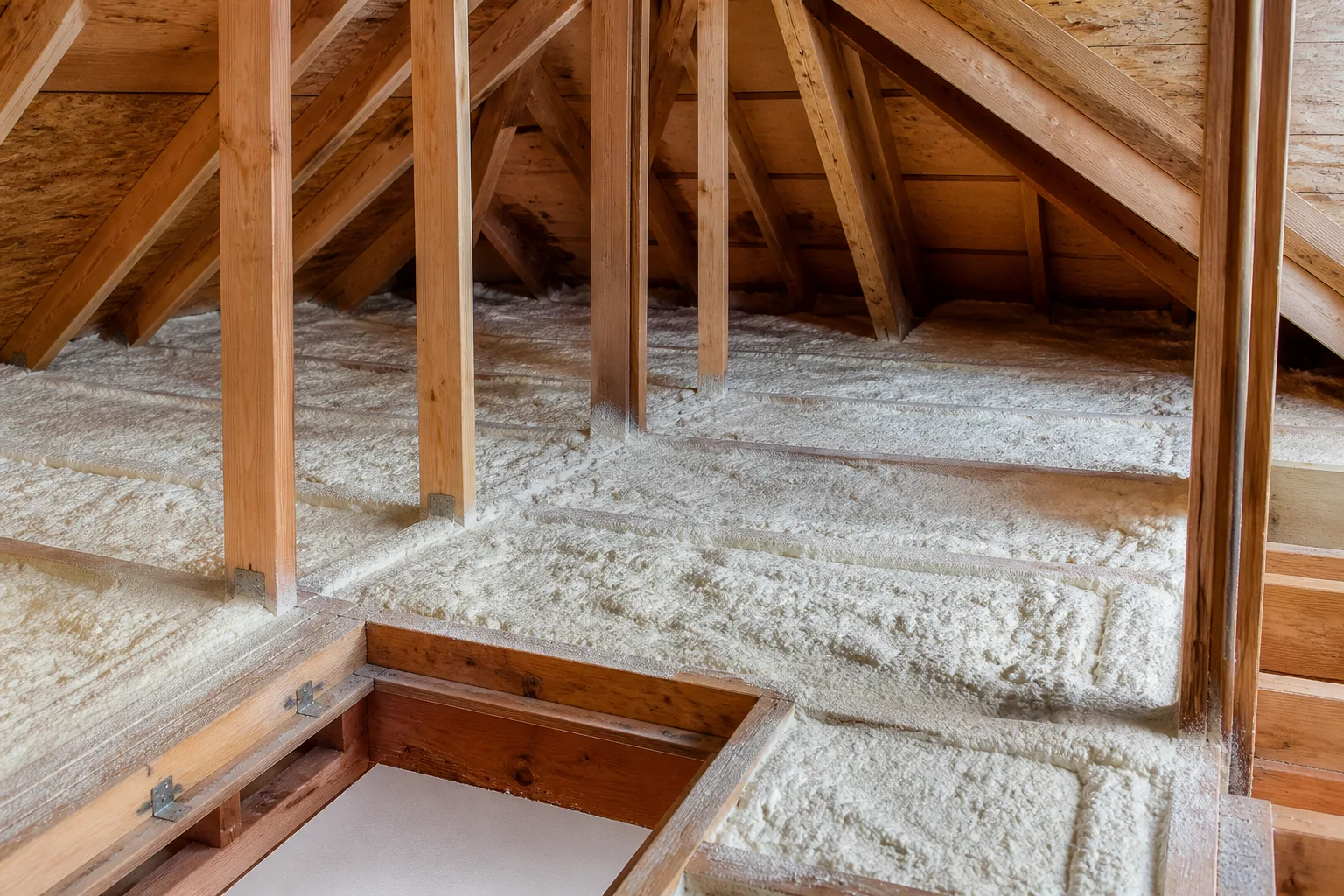
Demilec Attic Insulation in Winchester: A Homeowner’s Guide
Not every spray foam job is a Demilec job, and an installer who tells you otherwise is working from their supply chain, not your attic. Demilec makes both open-cell and closed-cell foam, and those two products solve very different problems in a Winchester attic where summer heat pushes roof-deck temperatures high enough to test adhesion and dimensional stability. This guide explains what Demilec does well, where another foam or a different material is the smarter call, and what a fair installed price looks like here.
If you’d rather not sort through product data sheets on your own, call (833) 382-4573 and we’ll walk your attic with you.
Key Takeaways
- Demilec covers both open-cell (Sealection) and closed-cell (Heatlok) foam, so the brand choice alone doesn’t tell you which product you’re getting.
- Open-cell foam is the right call for most interior attic air-sealing; closed-cell is the better fit where a roof deck gets genuinely hot or the assembly needs a vapor barrier.
- In Winchester, unvented “hot roof” designs in newer construction are where Demilec closed-cell earns its keep.
- Installed cost typically runs about $1.75 to $3.50 per square foot for open-cell and $3.75 to $7.00 per square foot for closed-cell, depending on depth and prep.
What makes Demilec different from other spray foam brands?
Demilec’s two product families are chemically distinct, and that distinction is the whole story. Heatlok is a closed-cell foam with a higher density and a built-in blowing agent that gives it a low permeability to moisture vapor. Sealection is an open-cell foam that expands more, cures softer, and lets vapor move through it. An installer who says “we spray Demilec” without naming which one hasn’t told you much.
What separates Demilec from the other foams on the market comes down to formulation behavior more than marketing. Closed-cell Heatlok cures to a rigid, dense matrix that holds its shape against thermal movement, which matters when a Winchester roof deck swings through big day-to-night temperature changes. Sealection’s open-cell structure stays flexible, which helps it stay bonded to framing that expands and contracts. Compared with Icynene, the other major brand we install, Demilec tends to have a firmer closed-cell hand and a somewhat denser open-cell texture; Icynene’s open-cell line is often chosen for its softer feel in living-space applications. Neither is objectively better. Which one fits your attic is the question.
One practical difference homeowners notice: the two products take different amounts of material to reach the same insulating performance, which is why foam quotes vary so widely between brands for what sounds like the same job.
How does Demilec open-cell foam handle Winchester’s attic heat?
Open-cell foam performs well in Winchester attics for air sealing and for moderating temperature swings across a vented attic floor, and it does so at a lower cost than closed-cell. Where it runs into trouble is directly under a roof deck that gets very hot in summer. Open-cell foam is more permeable and less dimensionally rigid, and at sustained high deck temperatures it can soften and, over time, lose some bond strength at the substrate if it wasn’t applied cleanly to begin with.
That’s not a knock on Demilec Sealection. It’s a statement about where open-cell belongs. For the typical Winchester attic where the foam goes on the flat ceiling plane and the roof stays vented above it, open-cell is a good, cost-effective choice:
- It seals the gaps around recessed lights, top plates, and penetrations that leak conditioned air.
- It keeps the attic from becoming a heat reservoir that radiates down into the rooms below.
- It moves vapor, which suits assemblies that aren’t designed as a barrier.
Where the foam meets a hot roof deck directly, closed-cell is the smarter call. More on that below.
Why Demilec closed-cell is often right for unvented attics in Winchester
Newer Winchester construction frequently uses unvented attic assemblies, sometimes called hot roof designs, where the insulation and air barrier go on the underside of the roof deck and the attic becomes part of the conditioned envelope. These assemblies work well, but they ask a lot of the foam: it has to bond tightly to the deck, resist thermal movement, and act as a vapor retarder.
That’s where Demilec Heatlok closed-cell foam fits. Its density and low permeability make it a natural choice where the roof deck itself is the insulated plane. The foam has to hold its grip through the deck’s expansion and contraction in summer heat, and closed-cell’s rigidity serves that better than a softer, more open material.
We work with both closed-cell and open-cell spray foam through Icynene and Demilec, which means the recommendation follows the assembly, not the warehouse. If your attic is a vented ceiling-plane job, open-cell may be the better value. If it’s an unvented deck job, closed-cell usually wins. We check which you have during the estimate before recommending either.
What does Demilec insulation cost in Winchester?
Installed Demilec foam in a Winchester attic typically runs about $1.75 to $3.50 per square foot for open-cell and $3.75 to $7.00 per square foot for closed-cell. Those are estimates for the installed product, not the raw material. The written estimate sets the final price.
| Product | Typical installed cost per sq ft | Best fit |
|---|---|---|
| Demilec Sealection (open-cell) | $1.75 – $3.50 | Vented attic, ceiling-plane air sealing |
| Demilec Heatlok (closed-cell) | $3.75 – $7.00 | Unvented roof deck, vapor control, higher performance |
What pushes a quote toward the top of those ranges:
- Depth. Foam is priced by board foot, so a deeper application to hit a performance target costs more.
- Prep work. Removing old insulation, sealing gaps, or protecting finished surfaces adds labor.
- Access. A tight attic hatch, ductwork in the way, or a steep roof pitch slows the crew down.
- Roof-deck jobs. Closed-cell applied overhead to a deck takes more care and more time than a flat floor spray.
The estimate is free, and it should itemize which product, what depth, and what prep is included. Call (833) 382-4573 to schedule yours.
What should you watch for during and after a Demilec installation?
Foam quality depends as much on the application as on the product, so these are the things to verify regardless of which contractor sprays it:
- Substrate prep. The deck or ceiling plane should be clean, dry, and free of dust before spraying. Foam won’t bond to a dusty surface.
- Pass thickness. Closed-cell foam is typically applied in lifts, with cure time between passes. Rushing that step can trap heat and cause shrinkage or voids.
- Uniform coverage. Look for even depth across the whole plane, not thick patches in the easy spots and thin coverage in the corners.
- No soft spots or gaps after cure. Run a hand along the foam. It should feel firm and bonded to the framing, with no pockets.
- Temperature and moisture conditions. Spray foam needs the right substrate temperature and humidity to cure properly. A crew that ignores those conditions on a hot Winchester day is cutting corners.
Spray foam application is not a DIY job. The chemicals require proper equipment, respiratory protection, and ventilation, and a badly applied job is expensive to fix. Leave the spraying to a trained professional.
When to call a pro
If you’re weighing open-cell against closed-cell, or you’re not sure whether your attic is vented or unvented, that’s the point to bring someone in. Getting that call wrong is the difference between foam that lasts and foam that peels. Our team installs across eight leading brands, including Demilec, Icynene, Owens Corning, and GreenFiber, and our technicians have up to 9 years of experience. We can also cover attic insulation in Winchester more broadly if foam turns out not to be your best fit.
Related services in Winchester: spray foam insulation for whole-home applications, and attic insulation for the full range of materials.
The Bottom Line
Demilec earns its reputation in Winchester for two reasons: its open-cell foam is a solid, cost-effective choice for vented attic air sealing, and its closed-cell Heatlok is one of the better foams for the unvented roof-deck assemblies that show up in newer construction. The catch is that “Demilec” by itself doesn’t tell you what you’re getting. The right product depends on your attic assembly, your goals, and your budget, and the answer isn’t the same for every home. Our technicians have up to 9 years of experience working with every major foam line, so the recommendation follows the job. If you’re in Winchester and need help, Attic Insulation Winchester offers free estimates. Call (833) 382-4573. We answer 24/7. Fast dispatch from 7am to 7pm, Sunday through Friday.
Frequently Asked Questions
Neither is universally better. Demilec’s closed-cell Heatlok is a strong fit for unvented roof-deck assemblies, while Icynene’s foam line is often chosen for its softer feel in living-space applications. The right pick depends on whether your attic is a vented ceiling plane or an unvented deck. Call (833) 382-4573 for an exact quote. Estimates are free.
For most vented attics where the foam goes on the flat ceiling plane, open-cell is the cost-effective choice. For unvented roof decks and assemblies that need a vapor barrier, closed-cell is the smarter call. The estimate visit is where we figure out which one your attic actually calls for.
A typical single-attic job usually takes one to two days, and it’s scheduled after the free estimate visit and a written quote. Closed-cell applications that require multiple lifts take longer because of cure time between passes. Call (833) 382-4573 to schedule your estimate. We answer 24/7, and dispatch runs 7am to 7pm, Sunday through Friday.
Yes. We visit, walk the attic, check the assembly, and leave you with a written quote at no charge. Pricing is set per job by that written estimate, with no service-call or diagnostic fee. Call (833) 382-4573 to book one.
Written by the team at Attic Insulation Winchester.
Need Insulation Help?
Call Attic Insulation Winchester - licensed & insured, with free written estimates in Winchester.
(833) 382-4573